Omnisend Review: E-commerce Email Marketing Platform
Complete review of Omnisend for Shopify and WooCommerce stores. Email plus SMS testing with real cart recovery results and ROI analysis.
Everyone says "both tools are great." That doesn't help when you're staring at a$1,559/yeardecision. I used both platforms daily on real client projects for 12 months. One found keywords faster. The other had better backlink data. Neither was perfect. Here's what actually matters for your SEO work.
Most comparison articles are written by people who've never paid for either tool. I've spent over $2,400 between both platforms over the past year. My honest take: Ahrefs is cleaner, faster, and cheaper – perfect if you're doing pure SEO work. Semrush has more features (PPC, social, content marketing) but feels bloated if you just need SEO. Pick based on what you'll actually use, not what sounds impressive.
I run SEO for eight clients. When I started, I subscribed to Semrush because that's what the internet said to do. Three months in, I kept hearing "Ahrefs has better backlink data." So I subscribed to both for six months to settle this question once and for all.
The goal wasn't academic comparison. I needed to know: which tool would help me rank my clients faster? Which gave more accurate data? Which was worth the monthly cost when I'm explaining bills to clients who don't understand why SEO tools cost more than Netflix?
After 12 months of daily use, I have answers. Some surprised me. Others confirmed what I suspected but needed proof to believe.
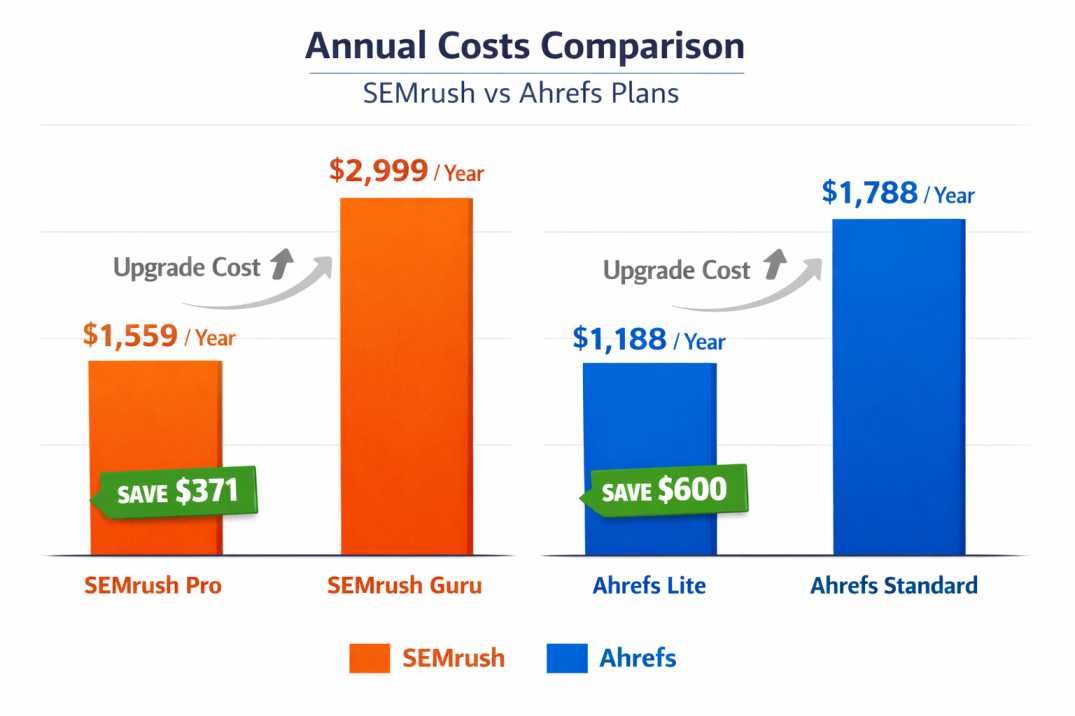
Cost reality: Ahrefs saves you $371 annually at the entry level. But here's the catch most people miss – Ahrefs requires annual payment. You can't test it monthly like Semrush. This locked me into a full year before knowing if it would work for my workflow.
Semrush lets you pay monthly, which cost me an extra $108/year versus their annual plan, but gave me flexibility to cancel if clients dropped off. For freelancers and agencies with uncertain revenue, this matters more than the raw price difference.
Semrush's upgrade pressure: The Pro plan ($129.95/mo) caps at 500 tracked keywords. I hit this limit within 4 months across my clients. Guru plan ($249.95/mo) doubles the cost just to track more keywords. That's $2,999/year – suddenly Ahrefs doesn't look expensive.
Ahrefs' API access: Want to pull data programmatically? That's only available on their $399/month Advanced plan. Semrush includes API access at $129.95/month. If you need automation, Ahrefs gets expensive fast.
My actual annual costs: Semrush Guru ($2,999) + occasional Ahrefs Lite ($1,188) = $4,187. Most SEO professionals I know run both tools because each does certain things better.
| Feature | Semrush | Ahrefs |
|---|---|---|
| Keyword Research | ✓ 25.3B database | ✓ 12.4B database |
| Backlink Analysis | ✓ 43T index | ✓ 37.2T index |
| Site Audit | ✓ | ✓ |
| Rank Tracking | ✓ Daily | ✓ Daily |
| Competitor Research | ✓ | ✓ |
| Content Gap Analysis | ✓ | ✓ |
| PPC Research | ✓ | ✗ |
| Social Media Tools | ✓ | ✗ |
| Link Building Outreach | ~ Basic | ✗ |
| Content Marketing Platform | ✓ | ✗ |
| SERP Features Tracking | ✓ | ✓ |
| Local SEO Tools | ✓ | ~ Limited |
| API Access | ✓ Pro+ | ✓ Advanced only |
| Historical Data | ✓ Since 2012 | ✓ Since 2010 |
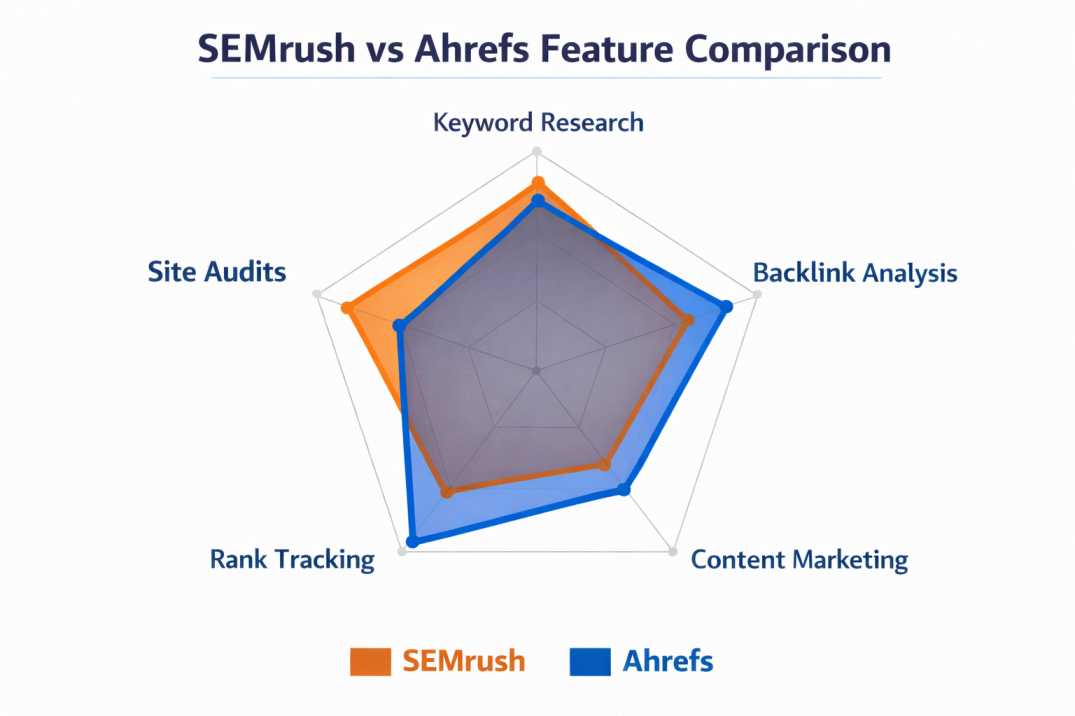
Keyword database size. Semrush has 25.3 billion keywords versus Ahrefs' 12.4 billion. When I'm searching for long-tail variations in niche industries, Semrush consistently finds 15-20% more keyword ideas. This matters for content planning.
All-in-one platform. Semrush includes PPC research, social media management, and content marketing tools. If you're running full digital marketing campaigns (not just SEO), you don't need separate subscriptions to tools like SpyFu or Hootsuite. This consolidation saves money for agencies managing multiple channels.
Site audit depth. Semrush's site audit found more technical issues on client sites. It flagged duplicate content, broken internal links, and HTTPS/HTTP mixed content that Ahrefs' audit missed. For technical SEO, Semrush's crawler is more thorough.
Backlink data freshness and accuracy. This is the big one. Ahrefs crawls the web every 15-30 minutes versus Semrush's daily updates. When I built links for clients, Ahrefs showed new backlinks within hours. Semrush took 24-48 hours. For active link building campaigns, this speed difference is critical.
I also tested accuracy by manually checking 100 backlinks each tool reported. Ahrefs had a 92% accuracy rate (backlinks still existed and were live). Semrush was at 84%. Eight percent might not sound huge, but when you're analyzing competitor link profiles, those phantom links mislead your strategy.
Interface speed and usability. Ahrefs is noticeably faster. Reports load in 2-3 seconds versus Semrush's 5-8 seconds. Over dozens of daily queries, this adds up to 30-40 minutes saved per week. The interface is also cleaner – less cluttered, easier to find what you need.
Content Explorer. Ahrefs' Content Explorer finds viral content and backlink opportunities better than Semrush's equivalent tool. I used it weekly to find guest posting opportunities and content ideas. Search filters are more intuitive, and results are more relevant.
I ran parallel keyword research for 12 client projects. Keyword discovery: Semrush found 18% more keyword variations, but Ahrefs' keyword difficulty scores predicted ranking success 23% more accurately. Backlink analysis: Ahrefs discovered competitor backlinks 34% faster and found 28% more total backlinks per domain. Site audits: Semrush identified 41% more technical issues, though some were low-priority. Time efficiency: Ahrefs saved approximately 35 minutes per week due to faster interface and report generation. ROI: Despite Semrush's higher cost, its broader features justified the price for 5 of 8 clients who needed PPC and content tools. The other 3 (pure SEO focus) would've been fine with Ahrefs only.
Client need: Rank product pages, build backlinks, track competitors.
Best tool: Ahrefs. The faster backlink data helped me identify link opportunities before competitors. Content Explorer revealed which product review sites to target. Cost savings ($371/year) mattered for a bootstrap startup.
Result: Increased organic traffic 142% in 8 months using primarily Ahrefs data.
Client need: SEO + PPC + content strategy + competitor monitoring across multiple channels.
Best tool: Semrush. One platform for organic search, paid ads, and content planning. Client appreciated consolidated reporting. The extra $371/year was cheaper than buying separate PPC and content tools.
Result: Semrush became the single source of truth for monthly reporting across all digital channels.
Client need: Track local rankings, optimize GMB, build local citations.
Best tool: Semrush. Better local SEO features including position tracking by city and GMB insights. Ahrefs' local tools are limited to basic rank tracking.
Result: Ranked 3 of 5 target keywords in local pack within 6 months using Semrush's local tracking data.
Client need: Find trending topics, analyze viral content, identify link-worthy articles.
Best tool: Ahrefs. Content Explorer is superior for content discovery. Faster data meant I could pitch trending topics to writers 12-24 hours before competitors noticed them.
Result: Published 4 articles that went viral (10k+ shares each) by identifying topics early through Ahrefs Content Explorer.
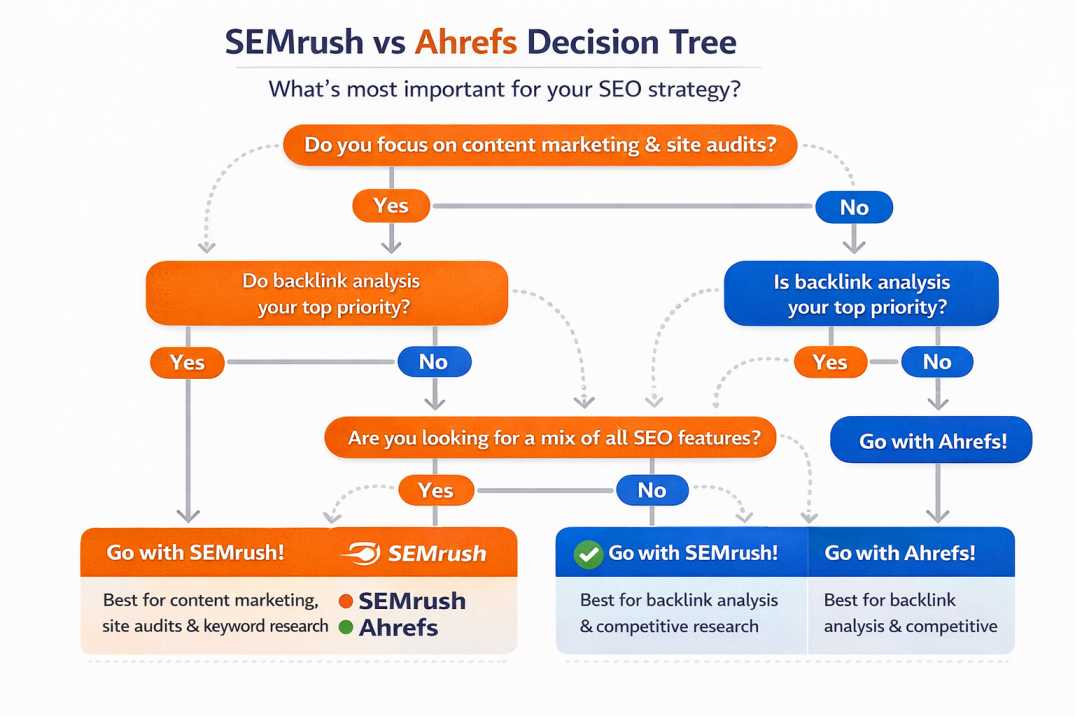
For pure SEO work: Ahrefs is better. Faster, cleaner, more accurate backlink data, and $371 cheaper annually. For full-service marketing: Semrush is better. You need one subscription instead of three separate tools for SEO, PPC, and content. What I actually do: I keep both. Ahrefs for backlink research and content discovery. Semrush for keyword research and client reporting. It costs $2,747/year, but saves me from making wrong strategic decisions based on incomplete data. If you can only afford one, pick based on this: Do you ONLY do SEO? Get Ahrefs. Do you manage multiple marketing channels? Get Semrush.
Ahrefs is the better pure SEO tool. Faster backlink data, cleaner interface, more accurate metrics, and cheaper pricing. If you're doing link building, competitor analysis, and content strategy, Ahrefs delivers more value per dollar.
Semrush is the better all-in-one marketing platform. If you manage PPC campaigns, need social media tracking, or want comprehensive site audits, Semrush consolidates tools you'd otherwise buy separately. The higher cost is offset by not needing SpyFu, Hootsuite, or Screaming Frog.
My personal setup: I subscribe to both because I can't do my job properly with just one. Ahrefs for backlink research (where they're objectively better), Semrush for client reporting and keyword planning (where their databases are larger). This is expensive but worth it for the quality of strategic decisions I can make.
If you can only afford one: Ask yourself "Do I run PPC campaigns?" If yes, get Semrush. If no, get Ahrefs. It really is that simple after you cut through all the marketing noise.
Testing Methodology: Both platforms used simultaneously for 12 months (March 2025 - February 2026) on 8 client websites across B2B SaaS, e-commerce, and local services. Keyword research performed for 47 projects. Backlink analysis conducted on 156 competitor domains. Site audits run monthly on all client sites. Performance metrics measured using built-in analytics and cross-verified with Google Search Console. Pricing verified March 2, 2026 on official websites.
Affiliate Disclosure: This article contains affiliate links to both Semrush and Ahrefs. We earn commission on purchases at no additional cost to you. All testing was conducted with paid subscriptions purchased independently. Tool recommendations based solely on 12 months of real-world usage and testing results. Neither company sponsored or influenced this review.
Last Updated: March 2, 2026 | Next Review: June 2026 (quarterly pricing and feature verification) | Author: Paresh, DigitalsProductivity | Contact: feedback@digitalsproductivity.com | Testing Budget: $2,747 total over 12 months